24. Ruth and Naomi: Loyalty and Reward (Ruth 1-4)
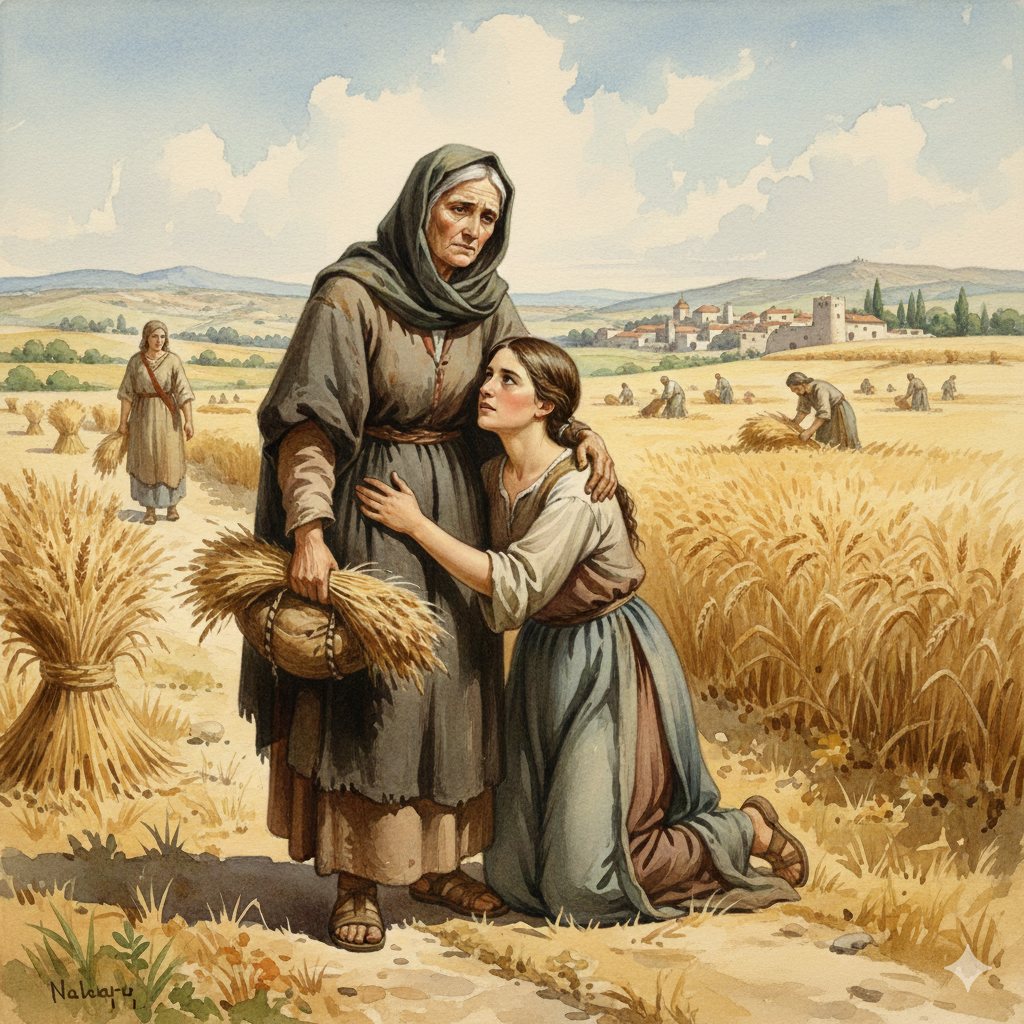
The story of Ruth takes place during a difficult time of famine and loss. Naomi, an Israelite woman, was left a widow and lost her two sons in a foreign land. When she decided to return to Bethlehem, her daughter-in-law Ruth, a Moabite, made a brave decision: instead of staying in her own country, she chose to accompany her mother-in-law. With the famous words "your people shall be my people, and your God my God," Ruth demonstrated extraordinary loyalty and faith.
Upon arriving in Bethlehem, Ruth began to work gleaning in the fields of Boaz to support Naomi. Her kindness and hard work did not go unnoticed. Boaz, a good man and a relative of Naomi, became her "kinsman-redeemer," marrying her and securing the future of both women. Ruth's faithfulness was rewarded in a surprising way: she, a foreigner, became the great-grandmother of King David and, therefore, a direct ancestor of Jesus Christ.
The Book of Ruth teaches us that God's providence acts in the small details of daily life. Ruth shows us that holiness is lived through faithfulness to family, simple work, and trust in God even in moments of bitterness. This story is a beautiful reminder that God does not distinguish between nations; His plan of salvation is open to everyone who, like Ruth, decides to take refuge under His wings with a noble and sincere heart.
Key Points according to the Bible
- Loyal Love: Ruth's decision not to abandon Naomi reflects God's faithful love for us.
- Providence: God guides Ruth's steps to Boaz's field to take care of them.
- Universality: Ruth, being a foreigner, is a fundamental part of the history of Salvation.
- The figure of the Redeemer: Boaz prefigures Jesus, who rescues us from spiritual poverty and gives us a new life.
Biblical Text
Consult the full biblical text of the Book of Ruth here: USCCB - Book of Ruth
Reflection Activities: Ruth 1-4
| 1. Text Comprehension: What phrase did Ruth say to Naomi that shows her conversion to the God of Israel, and which relative helped them in Bethlehem? |
| 2. Doctrinal Content: Why is it significant that Ruth, being a foreign woman (Moabite), is part of the genealogy of Jesus? |
| 3. Christian Anthropology: How can we apply Ruth's example of care and respect for her mother-in-law Naomi in our family relationships today? |
| 4. Catechetical Application: Boaz acted as a "redeemer." What does it mean to you that Jesus is our Redeemer in times of difficulty? |
| 5. Faith Commitment: Ruth trusted God in the midst of an unknown country. How can you trust the Lord more when you find yourself in new or difficult situations? |