16. Manna and Water from the Rock (Exodus 16-17)
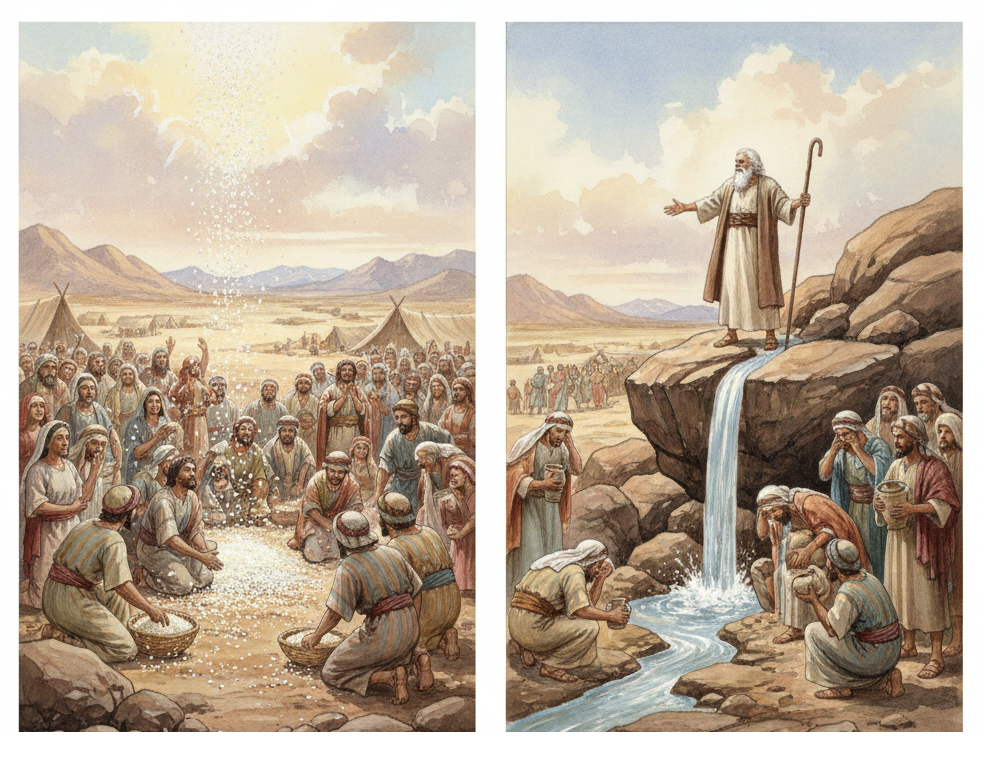
As the people of Israel journeyed through the desert toward the Promised Land, they began to suffer from hunger and thirst. Quickly forgetting the miracles of Egypt, they started to grumble against Moses and Aaron, even saying they would have preferred to die as slaves in Egypt with full bellies than to starve in the desert. In the face of this lack of faith, God responded with infinite patience and miraculous provision: every morning, the desert appeared covered with a white, fine substance, like hoarfrost, which the people called "Manna" (meaning "What is it?").
Manna was the "bread from heaven" that God gave them every day. They were to gather only what was necessary for the day, thus learning to trust in Divine Providence every morning. When the thirst became unbearable in a place called Meribah, the people protested again. The Lord commanded Moses to strike the rock at Horeb with his staff, and from the dry stone flowed abundant water for everyone. God was not only feeding them physically, but He was also teaching them that He was the source of all life in the midst of the desert.
These events are key to understanding God's relationship with us. Manna is a clear figure of the Eucharist, the true Bread from Heaven that sustains us on our journey toward eternal life. The water from the rock is an image of Jesus Christ, who is the "spiritual Rock" that follows us and quenches our thirst for happiness. The desert was the school where Israel learned that man does not live by bread alone, but by every word that comes from the mouth of God.
Key Points according to the Bible
- Daily Providence: God takes care of our basic needs at the precise moment.
- The Eucharist: Jesus presents Himself as the new and definitive Manna that gives life to the world.
- The Test of Faith: The desert serves to purify the heart and teach trust despite difficulties.
- The Living Water: Christ is the rock from which the water of the Holy Spirit flows to satisfy our hearts.
Biblical Text
Consult the full biblical text of the Manna and the water here: USCCB - Exodus Chapters 16-17
Reflection Activities: Exodus 16-17
| 1. Text Comprehension: How did the people react to hunger and thirst in the desert, and how did God respond to their complaints? |
| 2. Doctrinal Content: What is the relationship between the Manna of the Old Testament and the Sacrament of the Eucharist we receive today? |
| 3. Catechetical Application: How can we apply the phrase "Give us this day our daily bread" to our lives by trusting in God's Providence? |